The History of Finnish Lapphunds
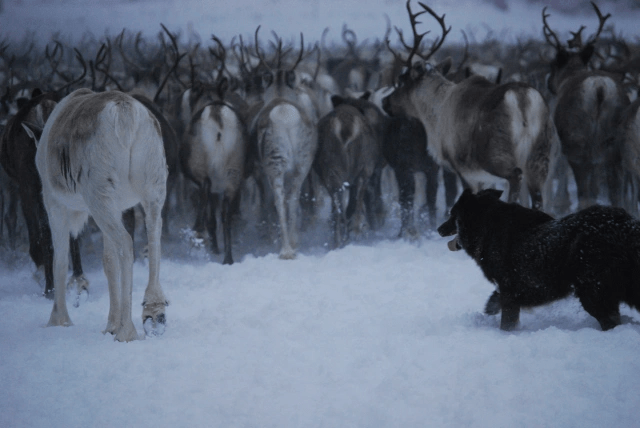
Also known as Suomenlapinkoira or the Finnish Lapponian Dog, the Finnish Lapphund is an old breed, originally used by the nomadic Sámi people of Northern Scandinavia and Karelian Russia and are possibly even as old as the sighthounds of Asia. Their original purpose, as with many dogs, were guard dogs but eventually, they were trained to assist the Sámi in reindeer herding. The Sámi people employ two types of Lapphunds in guarding and herding, the long-haired variety which is now known as the Finnish Lapphund (and Swedish Lapphund), and the short-haired variety which is commonly referred to as the Lapponian Herder.
The life of the Sámi people slowly changed in the 20th century. They became less nomadic and started settling down in permanent homes. Modern technology has resulted in less reliance on dogs for reindeer herding and increasingly more on the use of snowmobiles and, to some degree, helicopters. Some of the Sámi farmers that still use dogs also selected short-coated dogs to assist them with their herd. It was also at this point when the utility of the reindeer herding dog to the Sámi was diminishing that the interest in the same indigenous dogs was growing from the rest of Scandinavia.
Breed Recognition in Finland
Just after the Second World War, the Finnish Kennel Association have begun the work of creating and recognizing a breed based on the reindeer herding dogs of the Sámi. The breed was referred to as Lapponian Herder. In collaboration with the Lappish Kennel District and the Finnish Spitz Organization, the association scoured the reindeer farming area of the North and scrutinized dogs that fit the standard of the aforementioned Lapponian Herder.
The early 1960s saw the unification of the various Finnish Kennel organizations to form the Finnish Kennel Club. All the different Lapphund dogs that were registered in the various kennel organizations were accepted into the same breed register. However, breeders came to realize that some of the lines had shorter coats while others were definitely long-coated. The “lappish breed” was reassessed in 1966-1967 and it was decided that dogs were to be separated solely on the basis of their coat length. The short-coated Lapponian Herder (Lapinporokoira) was first officially recognized in 1966 and the long coated dogs identified as the “Lapinkoira” were designated as a distinct breed in 1967.
During the late 1960s and early 1970s, Marri Vainio of the Peski Kennel had made use of her good knowledge of the breed and took on the task of identifying individual dogs in the Lapplands and made significant contributions in breeding and stabilizing the “type” of the Lappland herder. A number of the early Lapphunds that were exported outside of Scandinavia were offsprings of the original Peski Kennel dogs brought down from the Lapplands.
The standard was further revised in 1975 and again in 1993. It is also in 1993 when the official name of the breed has also been changed from Lapinkoira to Suomenlapinkoira (Finnish Lapphund). In Finland, the breed registry is still open, allowing unregistered dogs to be admitted if they meet the breed standard.
Breed Recognition in Canada
It is quite possible the first Finnish Lapphunds in Canada were pets brought along by Finnish and other Scandinavian immigrants even as early as the 1960s but were either not registered or records misidentified them as a different breed.
In the spring of 1995, Diana Kinsey imported from the US, the first known Finnish Lapphund in Canada, the male Sugarok Echo of Jesse. It is worth noting that Jesse was from the kennel of Linda Marden, who was the pioneer in the organized and formal attempt to get the breed recognized in North America. A year later, Diana Kinsey imported the blonde female Sugarok Vaaleaverikko (Sasha). Despite a lot of pioneering work by Diana to get the attention of the CKC on the breed, both dogs were never bred.
In 1998, Catherine Healey adopted the female Sugarok Kewpie Pie who was 6 years old at that time, the third known Finnish Lapphund in Canada. Unfortunately, Kewpie unexpectedly died in 2001 and Linda Marden had intended to have one of her retired dogs, Sugarok Annisette (Annie) as a replacement. At almost the same time, Johanne Parent, a Eurasier breeder, was also interested in adopting and hopefully showing and breeding Finnish Lapphunds. An idea was struck to have Annie bred before being brought up to Canada. Johanne would take care of the pregnant Annie till she whelped and the puppies weaned before finally going to her permanent home with Cat Healey. Annie whelped on late December 2002, and her puppies became the first Finnish Lapphund litter to be registered with the Canadian Kennel Club. Since then, interest in the Finnish Lapphund breed has grown not only here in Canada but in all of North America. Janice Thomaschewski also adopted another bred female Lapphund from Sugarok (Sugarok Susa) in early 2004 whose litter became the second litter to be registered with the CKC. From that litter came My Sidekick Alera, who in June 2006, produced the first Canadian bred and born Finnish Lapphund litter.
On December 15, 2006, the CKC approved the decision for the Finnish Lapphund to be a “listed” breed effective July 1, 2007. This decision meant the breed was allowed to compete in CKC sanctioned events. The Finnish Lapphund Club of Canada gained accreditation afterward and is currently working on behalf of the breed to gain full recognition with the CKC in the near future.
The contents of this page were sourced from the Finnish Lapphund Club of Canada (FLCC) website
The CKC Breed Standard
General Appearence: Smaller than medium sized, its conformation is strong for its size, slightly longer than the height at the withers. Long and thick coated with pricked ears. Important proportions: The depth of the body is slightly less than half of the height at the withers. The muzzle is slightly shorter than the skull. The skull is slightly longer than broad, the depth is the same as the breadth.
Size:
Ideal height for males at the withers – 49 cm (19 inches)
Ideal height for females at the withers – 44 cm (17 inches)
With a tolerance of +/- 3 cm (just over 1 inch)
Type is more important than size
Coat & Colour:
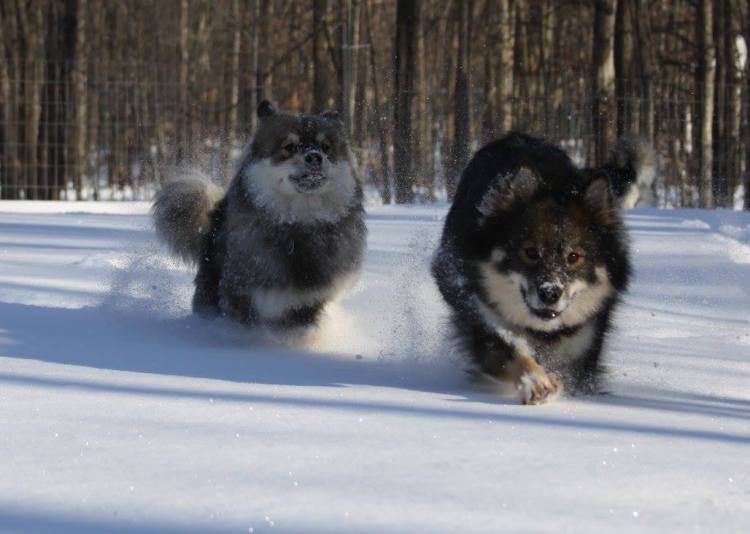
Skin is tight overall without wrinkles. Hair is profuse, the males especially have an abundant mane. The outer coat is long, straight and harsh. On the head and on the front of the legs, the coat is shorter. There must be a soft and dense undercoat
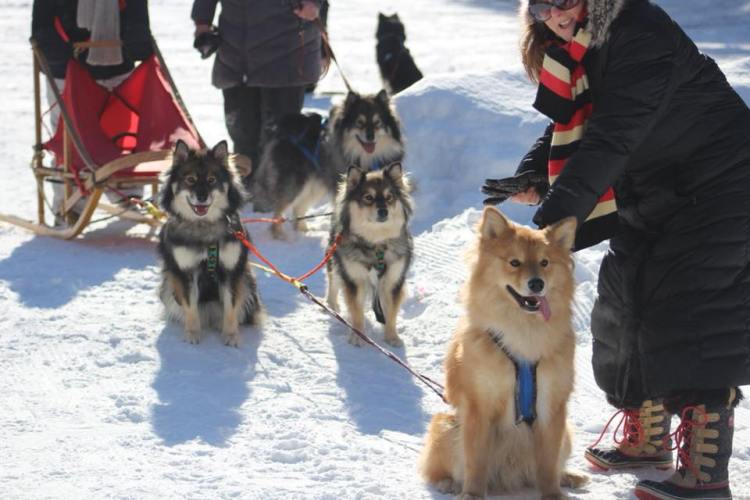
All colours are permitted. The basic colour must be dominant. Colours other than the basic colour can occur on head, neck, chest, underside of the body, on legs and tail (See Colours of The Finnish Lapphund by Caleebra Finnish Lapphunds)
Read the Full CKC Breed Standard here
Explore the Finnish Lapphund Visual Colour Guide
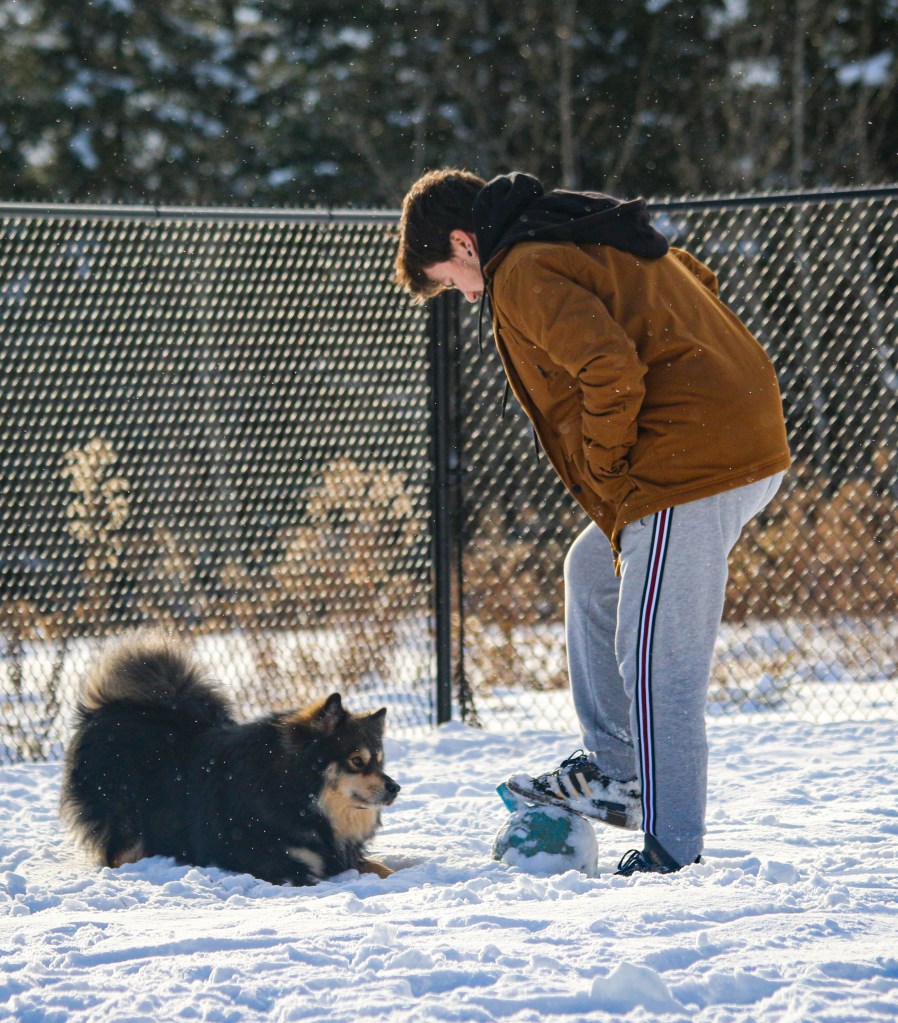
 TimberBay Finnish Lapphunds